Showing posts with label Politics. Show all posts

31/12/2013

Books of Mass Destruction

Books…

“Like any powerful tool, while it is considered to be the key to changing our lives by some, others may consider it to be a weapon of mass destruction.”

“The power of literature over communities and societies cannot be denied. Good literature is able to plant something in the minds of individuals, which may unify and form masses that can start revolutions, overthrow dictators, change laws and tradition and reshape the future. That “something” is an idea and there is no doubt that literature is the most efficient way to get that idea out there and plant it into minds.”

… “there was a time [...] when books were considered to be enough “evidence” to arrest young people and imprison them for the crime of being corrupt and even an enemy of the state. There was a time [...] in the course of the world’s history, when books were read, hastily devoured, then burnt or buried deep in the ground, like dead bodies, with the fear of getting captured, thrown into prison, tortured and perhaps even murdered.”

Alas, today…

“We have already begun to forget our past and literature’s divorce with politics had a lot to do with this collective amnesia”

More: http://www.yourmiddleeast.com/features/a-sour-love-affair-literature-and-politics-in-turkey_20109

28/12/2013

Democracy and Independent Publishing

"Sadly, now, publishing is almost entirely a matter of profitability, meaning that if you want to publish something that is immediately profitable, it’s very rare that it will turn out to be predicated on strong ideas, or dissident ideas.”

“That’s a big problem. It has considerably reduced the amount of good books published”.

… “without a free publishing industry, there can be no democracy.”

“Books today have become mere adjuncts to the world of mass media, offering light entertainment and reassurances that all is for the best in this, the best of all possible worlds … The resulting control on the spread of ideas is stricter than anyone would have thought possible in a free society.”

Sources:

http://www.thewhitereview.org/interviews/interview-with-andre-schiffrin/

http://america.aljazeera.com/opinions/2013/12/books-must-stop-beingasideshowtomassmedia.html

06/10/2013

In Literature United

The “fundamental conflict of our times is not the clash between two civilisations, but doctrines-religious and ethnic fundamentalism on the one hand, secular consumerist capitalism on the other.”

“It is true of terrorism as it is of modern civil conflicts that men of war prey on the ignorance of the populace to instill fear and arouse hatred”; “murderous, even genocidal ideologies took root in the absence of truthful information and honest education.”

“If only half the effort had gone into teaching those people what unites them, and not what divides them, unspeakable crimes could have been prevented”.

“Literature can bring down violence in today’s world as reading and writing broadens minds. … Two contradictory forces shape the world of letters today …  the first is globalisation of human imagination and the second is anxiety of audience.”

From: newindianexpress.com

29/01/2013

Literature a tool for Change

"Literature becomes important in arousing emotions and invoking and stressing some morality or even inculcating some attitude in the reader."

It can be an effective tool for change.

"Why is literature so powerful as a tool for change? It is because literature is in a very reflective nature, brings about social-political awareness and guides morality of the society by repudiating societal wrongs and upholding what is right. ...

Aristotle asserts that more philosophical than history in that whereas history deals with the past, literature deals with what might happen; the general probable – useful to sociologists, historians and philosophers. It is universally accepted that cognitive value in drama and novels is psychological – the human element makes it thus. Other utilities include preservation and creating continuity in the ways of life of societies."

From: http://thecitizen.co.tz/magazines/-/28441-try-reading-for-a-change


SpyWriter Jack King, Author of:
WikiJustice www.amzn.to/t3zd8Z
The Black Vault www.amzn.to/Na7QRO
The Fifth Internationale www.amzn.to/snl4w1
And announcing:

www.SpyWriter.com

15/01/2013

Truth or Myth: Politics and Novels don't mix

Interviewer: The question of combining politics and fiction has engaged a good many critics, often drawing from them the notion that it's very difficult to mix the two. 

John Dos Passos: Well, I don't know. Recently, I've been calling my novels contemporary chronicles, which seems to fit them rather better. They have a strong political bent because after all—although it isn't the only thing—politics in our time has pushed people around more than anything else. I don't see why dealing with politics should harm a writer at all. Despite what he said about politics in the novel being “the pistol shot at the opera,” Stendhal also wrote contemporary chronicles. Or look at Thucydides. I don't think his history was at all damaged by the fact that he was a political writer. A lot of very good writing has been more or less involved in politics, although it's always a dangerous territory. It's better for some people to keep out unless they're willing to learn how to observe. It is the occupation of a special kind of writer. His investigation—using blocks of raw experience—must be balanced. Sartre in his straight, plain reporting was wonderful. I can't read him now. A writer in this field should be both engaged and disengaged. He must have passion and concern and anger—but he must keep his emotions at arm's length in his work. If he doesn't, he's simply a propagandist, and what he offers is a “preachment."

More: http://www.ibna.ir/vdciv3azwt1awz2.ilct.html


SpyWriter Jack King || "A new King of thrillers on the horizon" || Author of Political Thrillers || www.SpyWriter.com

02/01/2013

Politics and religion divide, literature unites

"Politics or religion cannot unite, they only divide people. Only literature can act as a binding force... language may be regional but literature is universal. Language is not a barrier, it is our strength" ... Books are "treasure houses of words ... literature ignites culture. A writer begins the book and the reader finishes it. I think all books are left incomplete, as a writer takes the reader into the subject and leaves him to draw his own conclusion"...

... whereas politics and religion offer divisive demagoguery.

http://www.thehindu.com/news/cities/Vijayawada/only-literature-unites-people-pratibha-ray/article4265211.ece

SpyWriter Jack King Official WebPage, Facebook, and Twitter

24/10/2012

Politicians who don't read fiction are dangerous to society

We read fewer novels.

"It's not that the quality of fiction has gone downhill. It hasn't ...

Our attitude towards entertainment has changed, as has what we expect from a book. That's too bad, because we're missing something when we don't read fiction. To have politicians who don't read novels is particularly serious.

A good book is a window into how we as humans act and think. It makes us consider our own lives and those of people around us. Good writers introduce us to characters who, if they existed, would be unknowable by their local politicians. It's an indirect way of learning about our world.

A non-fiction book can educate us about the newest science on climate change or homelessness or psychology. But if you pick up a (non-fiction) book by a psychologist named Daniel Kahneman, you'll read that humans learn about abstract concepts and statistics better when they're told a story, rather than handed a stack of facts and figures."

More: http://www.edmontonjournal.com/touch/story.html?id=7431241

Politicians! Get to know and understand the peoples of the world before you decide to bomb them. Read!


Presidents are chosen, but not elected. The Black Vault. www.SPYWRITER.com

28/09/2012

Western writers becoming irrelevant

"I have a sense of people thinking it (literature) is less important," he told Reuters on Friday in a wide-ranging interview at Waterstone's book store in central London.  
"If you look at America, for instance, there is a generation older than mine in which writers like Susan Sontag and Norman Mailer and Gore Vidal would have a significant public voice on issues of the day. Now there's virtually no writers.  

"Instead you have movie stars, so if you are George Clooney or Angelina Jolie then you do have the ability to speak about public issues ... and people will listen in a way they would once listen to Mailer and Sontag. That's a change."  

He added that in authoritarian countries the situation was different, and literature had held on to some of its power.  

"In those places literature continues to be important as you can see by the steps taken against writers," he said, counting China among them."

More: http://www.gmanetwork.com/news/story/276085/lifestyle/literature/rushdie-says-writers-are-losing-their-influence-in-the-west


WikiJustice: WikiLeaks meets Jack London's The Assassination Bureau, Ltd. www.SPYWRITER.com

18/06/2012

The Black Vault

THE BLACK VAULT is any spy agency's most prized possession - those dirty and unaccountable funds that provide operational freedom outside of governmental scrutiny. They fund black operations - the stuff too dirty for any government to admit to.

How is the black vault funded, and what purpose does it serve?

"In the past, the CIA has been implicated in numerous scandals involving drug and weapons trafficking. From Vietnam and Iran to Latin America, the agency has repeatedly been caught importing narcotics and exporting arms for shadowy and subversive purposes."

"Citing an unnamed CIA source, a Washington Times article theorizes that U.S. officials were actively aiding organizations such as the Sinaloa cartel with guns and immunity in an effort to stymie Los Zetas. That’s because, according to the piece, the powerful and brutal criminal Zetas syndicate has the potential to overthrow the government of Mexico — and might be planning to do so."

Source: http://www.thenewamerican.com/world-mainmenu-26/north-america-mainmenu-36/8599-reports-cia-working-with-mexican-drug-cartels

What are black operations? What is the Black Vault? How is The Black Vault used? This, and more, in Jack King's new thriller novel: THE BLACK VAULT

[caption id="" align="aligncenter" width="500" caption="The black vault"]image[/caption]


### END OF POST ###
www.SPYWRITER.com

14/06/2012

Writers and Politics

"The best place for a writer is to remain on the fringes of society so as to keep a clear head, maintain alertness and avoid becoming another victim of the political propaganda apparatus...

Any political ideology serves politics ... while it is impossible for writers to separate themselves entirely from society, they should avoid meddling in politics.

Literature and arts ... should be a wakeful observation of the world and present the doubts one has about the world, not to negate it...

However, this is not to "entirely deny the value of having a person from literary circles in government ... the example of Andre Malraux, who made a great contribution to culture and the humanities when he was French minister of cultural affairs."

from: http://www.taipeitimes.com/News/taiwan/archives/2012/06/09/2003534901

Stendhal had a different take:

"Politics in a work of literature is like a gunshot at a symphony, it adds an element of thugness and simplicity, and yet we cannot ignore it. Although for many reasons we would prefer to remain silent about some of the subjects discussed herein, unfortunately we must talk about these nasty things."


### END OF POST ###
www.SPYWRITER.com

05/03/2012

The book for the Occupy Movement and the 99%

A book that was published in 1943, but... "One chapter in particular might have been written in 2012, not 1943. Its title: "Political Action for the 99%."

"Many of us have become cynical where politics is concerned. Corruption, class legislation and political irresponsibility no longer move us to indignation. Instead, we shrug our shoulders, as if to say, 'What can you expect?' This attitude threatens the whole democratic fabric of our country.

'The people's will must be made effective'

"Let there be no mistake: the political life of the country will be controlled, if not by the people, then by the vested interests. Indifference on our part is precisely the guarantee that special privilege will continue to rule. The people's will must be made effective. To achieve this end, they must gain control of economic and political power."

From: http://thetyee.ca/Books/2012/01/06/Prophets-Of-The-Occupiers/

Prefer a novel? Here's one, published in 2012, for the Occupy Movement, the 99percenters, and whistleblowers: WikiJustice.

05/02/2012

Writers as political instruments

"In order to introduce our literature to the world, we should first set our ideology, since nothing can change world beliefs as literature does.

Unfortunately most writers do not take effort in studying our contemporary history... All superior novels of the world are ideology-oriented.

Revolutionary literature [is] the subgenre of political literature and ... in the west, the effect of fiction on political and intellectual movements is measured and we see that before American invasion to Iraq, a number of novels had been written on the possibility of the event. They actually train their political writers and put them through valid and even ultra-confidential information.

In order to create revolution literature, we should first train researching writers who probe into the historical ground, causes and effects of revolution."

http://www.ibna.ir/vdciv3az3t1aru2.ilct.html

### END OF POST ###
www.SPYWRITER.com

30/11/2011

What hacker-activists have in common with secret services


"WikiLeaks raises the question as to what hackers have in common with secret services, since an elective affinity between the two is unmistakable. The love-hate relationship goes back to the very beginning of computing. One does not have to be a fan of German media theorist Friedrich Kittler or, for that matter, conspiracy theories, to acknowledge that the computer was born out of the military-industrial complex. From Alan Turing's deciphering of the Nazi Enigma code up to the role played by the first computers in the invention of the atomic bomb, from the cybernetics movement up to the Pentagon's involvement in the creation of the Internet – the articulation between computational information and the military-industrial complex is well established. Computer scientists and programmers have shaped the information revolution and the culture of openness; but at the same time they have also developed encryption ("crypto"), closing access to data for the non-initiated. What some see as "citizen journalism" others call "info war".

WikiLeaks is also an organization deeply shaped by 1980s hacker culture, combined with the political values of techno-libertarianism that emerged in the 1990s. The fact that WikiLeaks was founded – and to a large extent is still run – by hard-core geeks is essential to understanding its values and moves. Unfortunately, this comes together with a good dose of the less savoury aspects of hacker culture. Not that idealism, the desire to contribute to making the world a better place, could be denied to WikiLeaks: on the contrary. But this brand of idealism (or, if you prefer, anarchism) is paired with a preference for conspiracies, an elitist attitude and a cult of secrecy (never mind condescension). This is not conducive to collaboration with like-minded people and groups, who are relegated to being the simple consumers of WikiLeaks output. The missionary zeal to enlighten the idiotic masses and "expose" the lies of government, the military and corporations is reminiscent of the well-known (or infamous) media-culture paradigm from the 1950s."
MORE: http://www.eurozine.com/articles/2010-12-07-lovinkriemens-en.html

# END OF POST #
www.SpyWriter.com

19/11/2011

America, the House of Mirrors

"In this house of mirrors where endless war has made guilt and innocence or even facts irrelevant, the U.S. has left the realm of science and empiricism and entered a realm more mystical than real. It is a realm where ideology dictates plans and programs and not logic and empirical evidence.  It is a realm where ideology dictates who dies and who lives and is populated by men and women who can neither be understood nor reasoned with outside the confines of their own internal and hermetically sealed logic. 


From its inception during World War II, America’s military/intelligence apparatus has acted more as a subculture of America’s ruling elite than a bureaucracy dedicated to the nation’s security. It was said of America’s first spy agency the OSS that its initials stood for Oh-So-Social because of its abundant staffing with New York’s high society blue bloods. Victor Marchetti and John D. Marks even titled their 1974 book on their life in the CIA and Foreign Service as The CIA and the Cult of Intelligence. 


But over the last forty years and especially since the events of 9/11, that “Cult,” and its sister organizations in the military/intelligence community have emerged from behind the curtain to become a ubiquitous and forbidding presence.


In effect, 1974’s American “Cult” of intelligence has grown to become in 2011 the dominant American “Cult-ure.” But what that culture really is and where it’s leading us remains a frightening proposition that each and every American needs to understand."


Continue: http://m.officialwire.com/main.php?action=posted_news&rid=306786


Thrillers, Suspense, Espionage, Conspiracy: SPYWRITER.com

18/11/2011

Stalin’s deadly spy in the Fourth Internationale

image

"Mark Zborowski was the most notorious and deadly agent of the Soviet secret police (the GPU) inside the Trotskyist movement in the 1930s. He played a central role in setting up leading members of the Fourth International, including Trotsky’s son, Leon Sedov, for assassination. Zborowski survived his victims by many decades. Arriving in the United States in 1941, he made the transition from Stalin’s leading anti-Trotskyist agent to a highly successful academic in prestigious American universities. Zborowski’s eventual exposure as a Stalinist agent in the 1950s only temporarily derailed his academic career. But in 1975, as a result of the International Committee of the Fourth International’s investigation into the events leading up to the assassination of Trotsky in 1940, Zborowski’s crimes were brought to public attention. The GPU assassin was photographed in August 1975 in San Francisco outside his home by David North, a leading member of the Workers League (predecessor of the Socialist Equality Party). During the decade that followed, the International Committee’s investigation into the crimes of the GPU against the Trotskyist movement—whose findings were published under the title “Security and the Fourth International”—produced a wealth of new information about Zborowski’s activities. In June 1990, two months after Zborowski’s death, the International Committee published an obituary which reviewed the murderous career of this Stalinist agent. This obituary is republished below":


http://www.wsws.org/articles/2011/nov2011/zbor-n17.shtml

08/11/2011

Politics and literature

Should literature tackle political issues? France's prestigious literary prize awarded for Alexis Jenni's book makes it a resounding - Yes.


"It’s important to exorcise the unpleasant parts of history through literature, and not through political discourse, which doesn’t help at all. Thanks to fiction, we can probe deep into these problems and touch people’s consciences and hearts."


"It’s often said that literature has no place treating politics; that writers compromise fiction’s true potential as art when they turn their attentions to the big affairs of the day. Isn’t it more likely, though, that a bad book is a bad book, whether it’s an anti-war novel, a political thriller or chick-lit? Done right, politicised fiction soars, as Jenni’s achievement shows." From: http://mhpbooks.com/42574/the-goncourt-prize-should-fiction-and-politics-mix/


Or, as Stendhal put it: “Politics in a work of literature is like a gunshot at a symphony, it adds an element of thugness and simplicity, and yet we cannot ignore it. Although for many reasons we would prefer to remain silent about some of the subjects discussed herein, unfortunately we must talk about these nasty things."

06/11/2011

Why spies hang around toilets

"Deep inside the Central Intelligence Agency is a unit dedicated to uncovering the true physical and mental states of world leaders.  The Medical and Psychological Assessment Cell, or MPAC, employs or consults physicians, sociologists, political scientists, and cultural anthropologists to examine the conditions of top officials.


Agents will collect medical waste items, which can yield important information about someone’s medical condition.  


“No discarded bandage or something like a syringe should be discounted because you can draw DNA and blood types and you can do some examination on the contents of even a discarded band-aid to try to determine perhaps what’s wrong with that person. So, as unseemly as that may sound, this is what intelligence services do".


Then there are sort of apocryphal stories, which probably have some truth to it, that they have been able to surreptitiously obtain bodily fluids. And there are sort of several well-known examples of diverting plumbing in [the presidential guest residence] Blair House, or other places abroad where they are able to obtain stool and urine samples."


More: http://www.voanews.com/english/news/usa/Spies-Track-Physical-Illnesses-of-Foreign-Leaders-130222673.html

27/10/2011

How to foretell a dictator

image

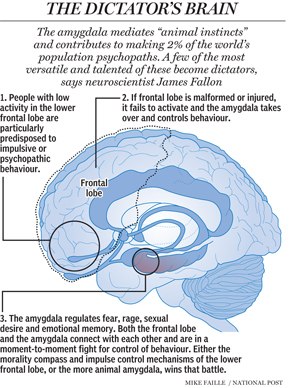
How to foretell a dictator? By scanning his brain (which, perhaps, should be a pre-requisite for all presidential candidates):


“They are usually charming, charismatic and intelligent,” wrote James Fallon, an American neuroscientist, in Psychology Today.


“They brim with self-confidence and independence, and exude sexual energy. They are also extremely self-absorbed, masterful liars, compassionless, often sadistic and possess a boundless appetite for power.”


Col. Gaddafi was “paranoid, narcissistic, power-hungry and vain,” he said.


After studying the behaviour of dictators, Mr. Fallon determined that genes, upbringing, abnormalities in the brain and a lack of empathy all played a role in forming such a person.


And, he concluded, “It is no coincidence that all dictators are men."


More: http://fullcomment.nationalpost.com/2011/10/22/peter-goodspeed-abnormal-brains-only-partly-explain-what-makes-someone-a-dictator/

07/09/2011

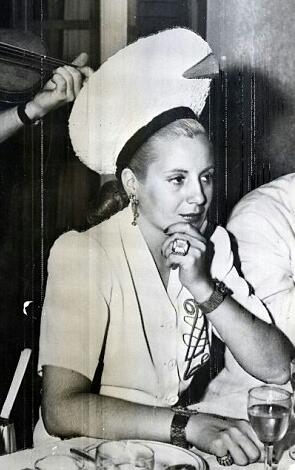
First Lady Eva Peron protected Nazis in exchange for looted treasures

image

"The former first lady of Argentina has been accused of accepting Nazi treasures stolen from wealthy families during the Holocaust in return for using her country as a safe haven.


According to a new book, Eva Peron and her husband, former president Juan Peron, kept quiet about the number of Nazis who were hiding out in Argentina after the Second World War.


In 'The Politically Incorrect Guide to Latin America,' authors Leandro Narloch and Duda Teixeira wrote: 'It is still suspected that among her [Eva Peron's] possessions, there were pieces of Nazi treasure that came from rich Jewish families killed in concentration camps.


In 1947, then First Lady Eva Peron included a brief trip to Switzerland during a publicity tour of Europe to try and boost the image of her husband's regime abroad.


According to historians, she may have opened at least one secret Geneva account to stash funds and valuables she allegedly received from Nazis in exchange for Argentine passports and visas."


Source: http://www.dailymail.co.uk/news/article-2033084/First-lady-Eva-Peron-allowed-Nazis-hide-Argentina-exchange-treasures-looted-rich-Jewish-families.html

05/09/2011

Operation Windsor

"Secret documents declassified Friday by Britain's MI5 security service reveal in dramatic and everyday detail how the U.K. under Prime Minister Winston Churchill overthrew the elected government of British Guiana — now Guyana — because he feared its left-wing leader and his American wife were leading the British colony into the arms of the Soviet Union.


The documents reveal how British spies kept up intense scrutiny on Cheddi and Janet Jagan, who founded the People's Progressive Party to campaign for workers' rights and independence from British rule for the sugar-producing colony in northern South America. [...]


After the party won a huge majority in British Guiana's 1953 election, making Cheddi Jagan prime minister, Churchill decided to act.


"We ought surely to get American support in doing all that we can to break the Communist teeth in British Guiana," Churchill wrote to his colonial secretary.


In the end, Britain acted alone, mounting a military operation code-named Operation Windsor. Churchill dispatched a warship, HMS Superb, and brought hundreds of troops by air and sea to secure key sites.


On Oct. 9, Britain suspended Guyana's constitution, fired its legislators and arrested the Jagans."


From: http://www.google.com/hostednews/ap/article/ALeqM5gPvzqBPqgNbtyhk901ZEM6oYbcsg


In other words nothing changed over the decades and the Empires employ same tactics when their interests are threatened.