"Once digitized, a page of words loses its fixity. It can change every time it's refreshed on a screen. A book page turns into something like a Web page, able to be revised endlessly after its initial uploading. There's no technological constraint on perpetual editing, and the cost of altering digital text is basically zero. As electronic books push paper ones aside, movable type seems fated to be replaced by movable text.
But as is often the case with digitization, the boon carries a bane. The ability to alter the contents of a book will be easy to abuse. School boards may come to exert even greater influence over what students read. They'll be able to edit textbooks that don't fit with local biases. Authoritarian governments will be able to tweak books to suit their political interests. And the edits can ripple backward. Because e-readers connect to the Internet, the works they contain can be revised remotely, just as software programs are updated today."
More: http://online.wsj.com/article/SB10001424052970203893404577098343417771160.html
### END OF POST ###
www.SPYWRITER.com
Showing posts with label E-books. Show all posts
Showing posts with label E-books. Show all posts
30/12/2011

17/10/2011
How do you discover ebooks?
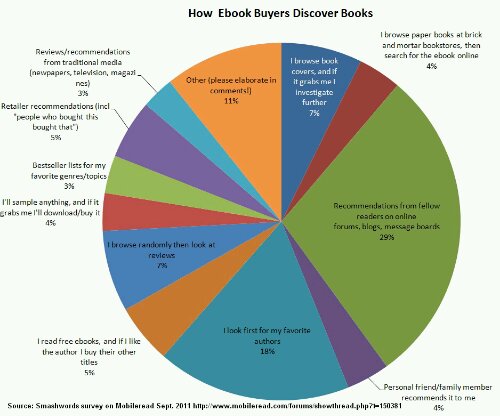
Survey from: http://www.teleread.com/paul-biba/how-ebook-buyers-discover-ebooks/
19/09/2011
Just why do writers write?
Do writers write solely for the money?
"Even for those of us lucky enough to have won a book deal, being an author is a pretty ghastly way to earn a crust. If being paid was our primary motivation, we'd have been far better off working in advertising or PR or posing as African princes to con idiots out of their savings. The reality is, those of us who write books for a living do so because we choose to: either because we have some burning desire to tell a story, or because we've tried real jobs and found ourselves lacking. We'd write for free (and frequently have done so)—but winning a book deal means we get to sleep till noon and spend our afternoons dicking around on YouTube when we should be typing. Moreover, the notion that authors have to choose between writing and a proper job has no basis in reality. Trollope, Kafka, Faulkner, Heller, Bukowski, Eliot, Grisham, King, Fleming, Chaucer... the list of authors who held down day jobs while working on their masterpieces is likely longer than those who didn't."
More: http://www.theawl.com/2011/08/mr-swifts-moronic-proposal-ebooks-will-keep-writers-from-writing
09/08/2011
Paolo Coelho scores riches through piracy
Author Paolo Coelho finds riches in piracy:
"His view is that letting people swap digital copies of his book increases sales. He gives this example of his experience in the Russian market where his books sold a mere 1,000 copies. He uploaded the Russian translation of his copy and the sales went up from 1,000 to 10,000 and more.
Once he found this avenue he says he set up his own site called ‘The Pirate Coelho’. He went to BitTorrent and got all his pirated editions and put them on his site. “Since then, my books have sold about 140 million copies worldwide,” he noted in his article.
According to him this gives a reader the possibility of reading your book and choosing whether to buy it or not."
Source: http://www.ibtimes.com/articles/189585/20110730/paulo-coelho-piracy-books-authors-the-alchemist.htm
26/07/2011
Death of book publishing conglomerates must not mean the end copyright
"Digitization has transformed both the work of the writer and the distribution of the book. Technological changes have called into question the principle of copyright: digital content is expected to be free for all, without compensation or remuneration. In the world of printed books and printed information, few would expect to obtain a work for free. In the information society, however, access to information, the arts and culture is sometimes referred to as the citizen's fundamental right, the right to get this information for free. It would seem that a new technological imperative has emerged: if it is possible to copy files for one¹s personal use and to distribute them, it must also be permissible and legal – and without charge.
Even though digitization does transform the world there are still various reasons for the maintenance of copyright:"
Continue: http://www.eurozine.com/articles/2011-07-26-hiidenmaa-en.html
23/06/2011
"What do we give up by reading an e-book?"

"What do we give up by reading an e-book?":
"...while e-readers (and e-book files) are more compact and portable than the traditional print book, we sacrifice the literal searchability of paper books. While paper books encourage us to read non-linearly, with a personal connection to the text, and to continue “reading” long after we’ve put down a book; e-readers and e-books may signal a different type of reading — something impermanent (more throwaway), less personal, more distracted, and ultimately less meditative."
And "The psychology of reading":
"The panelists in this session shared their findings on the psychology behind the act of reading. Their study is based on the definition of stories as model worlds that allow the reader to be both themselves and someone else at once. They compared the experiences of reading Chekov in his original form and re-written in plain language to find out whether content or literary quality causes both social- and self-transformation.
The panel worked at pinpointing why literary quality (and not content) makes the mind more malleable, leading to transformations in personality and emotion. This quality is elusive, of course. To bring it all back to technology, the panel ended by posing the question: “How are new technologies changing they way we experience self-transformation through narrative?"
source
05/05/2011
How do you read?
An interesting survey from China:
"A growing number of Chinese people have turned to digital reading, a trend insiders said will greatly improve the quality of literature.
Some 23 percent of respondents read books via mobile phones, 3.9 via e-book readers, 18 percent on the Internet, 2.6 percent by PDA (personal digital assistant)/MP4/electronic dictionaries", 52 in traditional paper format.
As the following graphic shows, at 16.8 minutes / day books fair quite well considering the fierce competition.
One peculiar comment from the director of the Academy of Press and Publication raises eyebrows: "E-books are a good rival to printed books and magazines. They can force traditional publications to produce even better quality works of literature." As though e-books are somehow different from printed editions! Of course it is something a "traditional", as in "paper publisher" would say. The only thing that differs is the method of delivery.
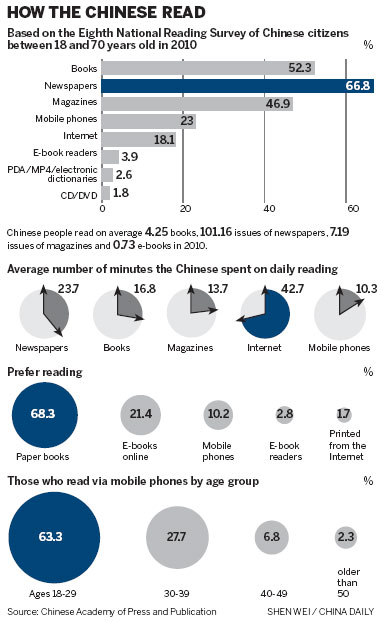
"A growing number of Chinese people have turned to digital reading, a trend insiders said will greatly improve the quality of literature.
Some 23 percent of respondents read books via mobile phones, 3.9 via e-book readers, 18 percent on the Internet, 2.6 percent by PDA (personal digital assistant)/MP4/electronic dictionaries", 52 in traditional paper format.
As the following graphic shows, at 16.8 minutes / day books fair quite well considering the fierce competition.
One peculiar comment from the director of the Academy of Press and Publication raises eyebrows: "E-books are a good rival to printed books and magazines. They can force traditional publications to produce even better quality works of literature." As though e-books are somehow different from printed editions! Of course it is something a "traditional", as in "paper publisher" would say. The only thing that differs is the method of delivery.
11/02/2010
eBook revolution benefits readers AND writers
Quill and Quire points out to the oncoming revolution that e-books are about to bring to what we read and write.
 As a writer you cannot look at it without your heart beating stronger. Do you smell it? Yes, that's what creative freedom smells like, it's the lack of constraints. Today, if your write and want to publish in North America (particularly when you write genre fiction), you have to ensure that your novel fulfills certain requirements. Unfamiliar with the North American publishing model? Think of it as a chain store, for instance HomeDepot -- big box, but in reality very limited choice. Call it uniformity. It comprises several points: broadly, if vaguely defined quality, book length, title, characters, even setting. These are all part of the scheme that you have to employ if you want to be considered for publication. At least one of those may be waved now and become irrelevant as far as production costs vs profit are concerned: book length. You may be able to forget the 100,000 word requirement, forget about filling blanks with scenery descriptions and pronouns. You can let your creativity reign, and pour out of you, even if it works out to "only" 70,000 words.
From a reader's standpoint, this is just as important. Were you putting away all seven volumes of Marcel Proust's classic, or that bulky War and Peace, afraid that they won't fit into your holiday suitcase, or on the subway? This all becomes irrelevant now. You can fit thousands more into your pocket, and it won't break your back. Do you like to read several books simultaneously, few pages here, few pages there? Good news: now you can carry your entire library with you, and dive into it anytime, wherever you are.
Welcome revolution. Welcome Che... I mean: eReader!

With the growing onslaught of e-readers and e-books, will readers see a shift in the average length of new books? Might we see longer books, because publishers are no longer constrained by the costs and sheer weight of a War and Peace-sized tome? Or will there be a deluge of novellas by authors freed from the pressure of writing a book of a certain length?
As a writer you cannot look at it without your heart beating stronger. Do you smell it? Yes, that's what creative freedom smells like, it's the lack of constraints. Today, if your write and want to publish in North America (particularly when you write genre fiction), you have to ensure that your novel fulfills certain requirements. Unfamiliar with the North American publishing model? Think of it as a chain store, for instance HomeDepot -- big box, but in reality very limited choice. Call it uniformity. It comprises several points: broadly, if vaguely defined quality, book length, title, characters, even setting. These are all part of the scheme that you have to employ if you want to be considered for publication. At least one of those may be waved now and become irrelevant as far as production costs vs profit are concerned: book length. You may be able to forget the 100,000 word requirement, forget about filling blanks with scenery descriptions and pronouns. You can let your creativity reign, and pour out of you, even if it works out to "only" 70,000 words.From a reader's standpoint, this is just as important. Were you putting away all seven volumes of Marcel Proust's classic, or that bulky War and Peace, afraid that they won't fit into your holiday suitcase, or on the subway? This all becomes irrelevant now. You can fit thousands more into your pocket, and it won't break your back. Do you like to read several books simultaneously, few pages here, few pages there? Good news: now you can carry your entire library with you, and dive into it anytime, wherever you are.
Welcome revolution. Welcome Che... I mean: eReader!
09/02/2010
eBook revolution fails foreign writers
All this talk about the Internet being a great democratizer of ideas, access, and reach proves meaningless for writers who create in languages other than English:


“Translations from Estonian are published mostly either by universities or by small publishing houses, and that brings fame and glory, but hardly any money.
E-books aren’t changing this much: the distribution opportunities change only in theory, because the language barrier doesn’t just disappear. On the contrary: The Internet is actually bolstering the role of English.
The chances that anyone apart from a couple of Estonians living in exile will read an Estonian-language book are next to zero. MORE
08/02/2010
Why proprietary e-Readers must die
The British Library will offer tens of thousands of public domain books for download. You can read them too... if you have a Kindle.
And that's why we do not need or want any proprietary technology. Give us the books without any conditions!
Jane Austen

MORE than 65,000 19th-century works of fiction from the British Library’s collection are to be made available for free downloads by the public from this spring.
Owners of the Amazon Kindle, an ebook reader device, will be able to view well known works by writers such as Charles Dickens, Jane Austen and Thomas Hardy, as well as works by thousands of less famous authors.
The library’s ebook publishing project, funded by Microsoft, the computer giant, is the latest move in the mounting online battle over the future of books.
While some other services, such as Google Books, offer out-of-copyright works to be downloaded for free, users of the British Library service will be able to read from pages in the original books in the library’s collection. MORE
And that's why we do not need or want any proprietary technology. Give us the books without any conditions!
Jane Austen

07/02/2010
e-Reader owners like their gizmos
Market research survey results:

E-Reader satisfaction is high among owners, according to a new report e-Reader Owners: Attitudes and Usage from leading market research company The NPD Group. Almost all owners (93 percent) said they were “very satisfied” or “somewhat satisfied” with their device. Only 2 percent of owners expressed any level of dissatisfaction.
Features are important to e-Reader owners. According to the report, 60 percent of owners said wireless access was their favorite feature on their e-Reader; touch was mentioned by 23 percent of owners. [...]
Even with great features, e-Reader owners are still looking for more in these relatively new and still evolving devices. Some recommended improvements from owners include more book title availability, longer battery life, and color screens at 42 percent, 39 percent, and 34 percent respectively. Content is important, and while almost half (46 percent) of owners said they were mostly satisfied with the selection of titles for their e-Reader devices, only 39 percent said they could find every title they were looking for.
But it seems that e-Reader owners aren’t married to their e-Readers to do their reading. About three-in-ten owners say they use at least one another device for reading e-books, such as a PC or a smartphone. MORE HERE
21/09/2009
Good old days resurrected
Close to 200 years ago, a writer wrote in his historical novel...
The novel is available as a free ebook download.

Torture was then so rooted in the practice of justice that the beneficial instructions ordaining its abolition remained a long time of none effect. It was thought that the confession of the accused was indispensable to condemnation, an idea not merely unreasonable, but contrary to the dictates of the simplest good sense in legal matters, for, if the denial of the accused be not accepted as proof of his innocence, the extorted confession should still less serve as proof of his guilt. Yet even now I still hear old judges sometimes regret the abolition of this barbarous custom.Alexander Pushkin, The Captain's Daughter
The novel is available as a free ebook download.
Subscribe to:
Posts (Atom)