Publishers and literary agents do not always know better. Here are some books / writers that almost did not become published:
“Not only does this bog down in the middle, but the author tends to
stay too long with non essentials. He seems to have little idea of pace,
and is enchanted with his words, his tough style, and that puts me off
badly.” Re: The Ipcress File, by Len Deighton.
“Things improve a bit with the rebuilding of the village but then go
to hell in a hack at the end. Perhaps there is a public that can take
all this with a straight face but I’m not one of them.” Re: Welcome to
Hard Times, by E.L. Doctorow
“It does not seem to us that you have been wholly successful in working out an admittedly promissing idea.” Re: Lord of the Flies, by William Golding.
“A duller story I have never read. It wanders a deep mire of affected
writing and gets nowhere, tells no tale, stirs no emotion but
weariness.” Re: In the Cage, by Henry James.
The novel is “… rather discursive and the point of view is not an
attractive one.” Re: A Portrait of the Artist as a Young Man, by James
Joyce.
“I’m sorry, Mr. Kipling, but you just don’t know how to use the English language.” Re: Untitled work by Rudyard Kipling.
“You’re welcome to le Carre – he hasn’t got any future.” Re: The Spy Who Came in From the Cold, by John le Carre.
“… superficial and unconvincing. I do not see this book as a very well told story on any level.” Re: The Assistant, by Bernard Malamud.
“It is impossible to sell animal stories in the U.S.A.” Re: Animal Farm, by George Orwell.
“A long, dull novel about an artist.” Re: Lust for Life, by Irving Stone.
“It is not interesting enough for the general reader and not thorough
enough for the scientific reader.” Re: The Time Machine, by H.G. Wells.
“It contain unpleasant elements.” Re: The Picture of Dorian Gray, by Oscar Wilde.
Frederic Forsyth‘s The Day of the Jackal was rejected by nearly 50 publishers.
Agatha Christie’s The Mysterious Affair at Styles was rejected by six publishers.
Tom Clancy’s The Hunt for Red October was rejected by over two dozen publishers.
Jack King’s The Fifth Internationale was rejected almost 500 times.
John Grisham’s A Time to Kill was turned down by 28 publishers.
Robert Pirsig’s Zen and the Art of Motorcycle Maintenance was rejected 121 times.
Margaret Mitchell’s Gone with the Wind was rejected 38 times.
The list goes on… As George Bernard Shaw said: “I object to
publishers: the one service they have done me is to teach me to do
without them.
They combine commercial rascality with artistic touchiness and
pettishness, without being either good business men or fine judges of
literature. All that is necessary in the production of a book is an
author and a bookseller, without the intermediate parasite.”
Showing posts with label Publishing. Show all posts
Showing posts with label Publishing. Show all posts

23/04/2013
Quick Writers
"New writers tend to think that editing merely means a brief read through for typos and spelling errors. That is the very last thing to do. The best writers re-write and re-write.
Too many [...] Authors are going into the world of letters with dreams of instant stardom. For them, it was more important to see their book published than to make sure it is a quality product. They are approaching writing the same way one would approach the selling of second hand shoes with an eye to quick profit and a big launch with a lot of deep pocket donors. They have no desire to go through the pains and hassles of a thorough editorial process.
Make sure you are not one of those writers."
From: http://m.allafrica.com/stories/201304221800.html/
SpyWriter Jack King, the author of:
Agents of Change, WikiJustice, The Black Vault, and The Fifth Internationale.
Books by Jack King:

www.SpyWriter.com
Too many [...] Authors are going into the world of letters with dreams of instant stardom. For them, it was more important to see their book published than to make sure it is a quality product. They are approaching writing the same way one would approach the selling of second hand shoes with an eye to quick profit and a big launch with a lot of deep pocket donors. They have no desire to go through the pains and hassles of a thorough editorial process.
Make sure you are not one of those writers."
From: http://m.allafrica.com/stories/201304221800.html/
SpyWriter Jack King, the author of:
Agents of Change, WikiJustice, The Black Vault, and The Fifth Internationale.
Books by Jack King:
www.SpyWriter.com
22/01/2013
I Doubt therefore I Write
"The brains of writers aren’t filled with only yet-to-be-penned stories. They’re loaded with insecurities, doubts, and uncertainties. These can range from the minor to the more melodramatic (My writing is a mere shack to Faulkner’s pa . Why bother?)
And I won’t even dwell on the disheartening contemporary literary landscape. Snooki is a New York Times bestselling author. How’s that for soul-crushing?
It’s easy to become defeatist and even disillusioned when rejections roll in and when the unexplainable, unjust literary success of dimwitted celebs destroys our faith in the American public’s ability to appreciate good work.
In the face of rejection and dismay, from where can we draw encouragement?
Famous Writers Show: Rejection and late bloomers abound.Laura Ingalls Wilder didn’t begin writing until she was 44. She published the first of the Little House books when she was 64 years old. While Charles Bukowski’s first story was published when he was 24 years old, he didn’t receive a major offer from a publisher until age 44. He published his first novel, Post Office, at age 51.
And it’s no secret that a tremendous number of now-famous books were rejected—some multiple times. William Faulkner’s The Sound and the Fury and As I Lay Dying failed to earn him enough royalties to support his family. E.B. White was a firm believer in “the doctrine of immaculate rejection.” When he mailed in his manuscripts, he included a stamped envelope for the rejection letter.
The point is, even the writers whose work we now revere didn’t have an easy go of it; even the best didn’t instantly achieve success."
More: http://www.business2community.com/content-marketing/how-to-overcome-the-most-common-writing-obstacles-according-to-the-literary-greats-0379054
SpyWriter Jack King || "A new King of thrillers on the horizon" || Author of Political Thrillers || www.SpyWriter.com
And I won’t even dwell on the disheartening contemporary literary landscape. Snooki is a New York Times bestselling author. How’s that for soul-crushing?
It’s easy to become defeatist and even disillusioned when rejections roll in and when the unexplainable, unjust literary success of dimwitted celebs destroys our faith in the American public’s ability to appreciate good work.
In the face of rejection and dismay, from where can we draw encouragement?
Famous Writers Show: Rejection and late bloomers abound.Laura Ingalls Wilder didn’t begin writing until she was 44. She published the first of the Little House books when she was 64 years old. While Charles Bukowski’s first story was published when he was 24 years old, he didn’t receive a major offer from a publisher until age 44. He published his first novel, Post Office, at age 51.
And it’s no secret that a tremendous number of now-famous books were rejected—some multiple times. William Faulkner’s The Sound and the Fury and As I Lay Dying failed to earn him enough royalties to support his family. E.B. White was a firm believer in “the doctrine of immaculate rejection.” When he mailed in his manuscripts, he included a stamped envelope for the rejection letter.
The point is, even the writers whose work we now revere didn’t have an easy go of it; even the best didn’t instantly achieve success."
More: http://www.business2community.com/content-marketing/how-to-overcome-the-most-common-writing-obstacles-according-to-the-literary-greats-0379054
SpyWriter Jack King || "A new King of thrillers on the horizon" || Author of Political Thrillers || www.SpyWriter.com
28/12/2012
Christmas Eve Tradition: Reading
"So Icelanders love books. And that love involves most of the population, according to Baldur Bjarnason, a researcher who has written on the Icelandic book industry. ...
In the United States, popular holiday gifts come and go from year to year. But in Iceland, the best Christmas gift is a book — and it has been that way for decades.
Iceland publishes more books per capita than any other country in the world, with five titles published for every 1,000 Icelanders. But what's really unusual is the timing: Historically, a majority of books in Iceland are sold from late September to early November. It's a national tradition, and it has a name: Jolabokaflod, or the "Christmas Book Flood."
"The culture of giving books as presents is very deeply rooted in how families perceive Christmas as a holiday" ... "Normally, we give the presents on the night of the 24th and people spend the night reading."
From: http://www.npr.org/2012/12/25/167537939/literary-iceland-revels-in-its-annual-christmas-book-flood
SpyWriter Jack King
28/11/2012
The Victims
Two giant publishing conglomerates want to merge. What it means to readers, writers, and other insiders?
"One single publishing house usually contains multiple imprints with distinct identities and tastes. Agents typically pitch one book to one imprint at one house, although the exact rules differ from publisher to publisher. The rule at Penguin is that agents cannot pitch to multiple imprints within the group; imprints cannot bid against each other for the same manuscript. At Random House, imprints can bid against each other as long as they are not in the same immediate group. After the Penguin Random House merger, agents could see pitching options abruptly diminished if Penguin's rules are retained in the new conglomerate."
This, as the publishing mergers of the 1990's, means a narrowing gate into publication. See what it takes to publish a book: www.spywriter.com/dta/
More: http://www.thedailybeast.com/articles/2012/11/27/the-victims-of-the-penguin-random-house-merger-literary-agents.html
"One single publishing house usually contains multiple imprints with distinct identities and tastes. Agents typically pitch one book to one imprint at one house, although the exact rules differ from publisher to publisher. The rule at Penguin is that agents cannot pitch to multiple imprints within the group; imprints cannot bid against each other for the same manuscript. At Random House, imprints can bid against each other as long as they are not in the same immediate group. After the Penguin Random House merger, agents could see pitching options abruptly diminished if Penguin's rules are retained in the new conglomerate."
This, as the publishing mergers of the 1990's, means a narrowing gate into publication. See what it takes to publish a book: www.spywriter.com/dta/
More: http://www.thedailybeast.com/articles/2012/11/27/the-victims-of-the-penguin-random-house-merger-literary-agents.html
16/11/2012
Getting published is an aggregate of chance
''even lousy literature is written by outsiders'' or ''to linger round the bookstore alcove dedicated to how-to-write books is to grow acquainted with the many species of human expectation''.
As those two introductions suggest, Bissell remains enthralled with the job of writing. That preoccupation is not focused on the common delusions that something about writing might really be learnt by knowing which type of pen authors use, what hours they keep or whether they listen to music.
Bissell concentrates on the task of actually getting published. His first essay challenges the notion that ''the sweetest cream eventually rises to the top'', suggesting that literary success might be partly attributed to an ''accumulation of non-literary accidents'' or, indeed, ''the yield of an inert aggregate of chance''.
Bissell's organising idea is that ''the publishing industry as a whole does literature few favours'', and he deploys an impressive accumulation of evidence of chance and accidents to attest that thesis."
More: http://m.smh.com.au/entertainment/books/a-read-about-writing-20121116-29fdj.html
How to Publish a book: www.SPYWRITER.com/dta/
As those two introductions suggest, Bissell remains enthralled with the job of writing. That preoccupation is not focused on the common delusions that something about writing might really be learnt by knowing which type of pen authors use, what hours they keep or whether they listen to music.
Bissell concentrates on the task of actually getting published. His first essay challenges the notion that ''the sweetest cream eventually rises to the top'', suggesting that literary success might be partly attributed to an ''accumulation of non-literary accidents'' or, indeed, ''the yield of an inert aggregate of chance''.
Bissell's organising idea is that ''the publishing industry as a whole does literature few favours'', and he deploys an impressive accumulation of evidence of chance and accidents to attest that thesis."
More: http://m.smh.com.au/entertainment/books/a-read-about-writing-20121116-29fdj.html
How to Publish a book: www.SPYWRITER.com/dta/
18/10/2012
Why we read
"Literature has always been a catalyst through which humans can find humor, adventure, or an escape from their everyday. However, I would argue that entertainment is not the most important role of literature, either. These two functions can be found in other forms of media as well. Literature holds no advantage over film or art in this case, except perhaps to contain a greater amount of information in one place.
What, then, is the purpose in reading? What advantage does it give us, if not to entertain, educate, or explore? What abilities does the act of reading print words in a paper novel grant us above any other medium?
Reading gives us a window into another’s mind, in a way that cannot be duplicated in another medium. Whether it is greater than other mediums, such as art or film, is perhaps a matter of opinion. However, it’s clear that literature offers an experience of empathy matchless in its sincerity."
More: http://www.theracquet.net/mobile/features/why-read-1.2930145
Presidents are chosen, but not elected. The Black Vault. www.SPYWRITER.com
What, then, is the purpose in reading? What advantage does it give us, if not to entertain, educate, or explore? What abilities does the act of reading print words in a paper novel grant us above any other medium?
Reading gives us a window into another’s mind, in a way that cannot be duplicated in another medium. Whether it is greater than other mediums, such as art or film, is perhaps a matter of opinion. However, it’s clear that literature offers an experience of empathy matchless in its sincerity."
More: http://www.theracquet.net/mobile/features/why-read-1.2930145
Presidents are chosen, but not elected. The Black Vault. www.SPYWRITER.com
17/10/2012
The rise of the academic novel
"The academic novel is usually considered a quaint genre, depicting the insular world of academe and directed toward a coterie audience. But it has become a major genre in contemporary American fiction and glimpses an important dimension of American life.
...there are simply an overwhelming number of academic novels. Drawing data from the standard bibliography, there were 70 published between 1990 and 2000, and 238 from 1950 to 2000. That doesn’t include mysteries, of which there are about 500 in the same period. It also specifies novels that center on faculty or staff rather than students (the latter I would distinguish as “the campus novel,” since they usually turn on student life on campus)."
The rise of the academic novel:

More: http://blog.oup.com/2012/10/rise-of-academic-novel-genre-american-literary-history/
The Election. The Coup. The Black Vault. www.SPYWRITER.com
...there are simply an overwhelming number of academic novels. Drawing data from the standard bibliography, there were 70 published between 1990 and 2000, and 238 from 1950 to 2000. That doesn’t include mysteries, of which there are about 500 in the same period. It also specifies novels that center on faculty or staff rather than students (the latter I would distinguish as “the campus novel,” since they usually turn on student life on campus)."
The rise of the academic novel:
More: http://blog.oup.com/2012/10/rise-of-academic-novel-genre-american-literary-history/
The Election. The Coup. The Black Vault. www.SPYWRITER.com
Distrusting Literary Prizes
"why are prizes so mistrusted these days? There are many possible answers, but two make, out of this many, more sense.
Prizes have become banal. There is a prize, an award, for almost every thing. And every writer that wants to sell enough books to make a living out of it, must, at least, have been laureled once or twice. The excess of awards makes them less valuable, thus also taking value from the awardee, person and book. ...
Still, awards play an immensely important part in today’s literary panorama. They tell people what to read. ... They might teach what, but not why.
In addition, creative writing courses seem to be contributing to this overall lack of literary sensibility. By slowly replacing literature graduations – that focus, essentially, on reading – creative writing courses are manufacturing more writers than readers, and therefore unbalancing the scale dangerously. This leads to the necessity of more awards to inform people of what to read. And publishers, of course, say thank you very much. By trying to perpetrate one artistic form, creative writing courses are slowly slaughtering it."
More; http://www.independent.co.uk/voices/our-voices/battle-of-ideas/forget-the-booker-the-prize-every-author-really-wants-is-academic-validation-8213065.html
The Election. The Coup. The Black Vault. www.SPYWRITER.com
Prizes have become banal. There is a prize, an award, for almost every thing. And every writer that wants to sell enough books to make a living out of it, must, at least, have been laureled once or twice. The excess of awards makes them less valuable, thus also taking value from the awardee, person and book. ...
Still, awards play an immensely important part in today’s literary panorama. They tell people what to read. ... They might teach what, but not why.
In addition, creative writing courses seem to be contributing to this overall lack of literary sensibility. By slowly replacing literature graduations – that focus, essentially, on reading – creative writing courses are manufacturing more writers than readers, and therefore unbalancing the scale dangerously. This leads to the necessity of more awards to inform people of what to read. And publishers, of course, say thank you very much. By trying to perpetrate one artistic form, creative writing courses are slowly slaughtering it."
More; http://www.independent.co.uk/voices/our-voices/battle-of-ideas/forget-the-booker-the-prize-every-author-really-wants-is-academic-validation-8213065.html
The Election. The Coup. The Black Vault. www.SPYWRITER.com
15/08/2012
Writers and morality
"Political correctness is now about to affect the behaviour of writers, with the American arm of HarperCollins introducing a "morality clause" that gives it the right to terminate a contract if "an author's conduct evidences a lack of due regard for public conventions and morals or if such behaviour would materially damage the work's reputation or sales".
Ironically - HarperCollins, one of the Big Five publishers, is part of the entertainment and media empire run by Rupert Murdoch of the phone hacking scandal...
http://www.independent.ie/entertainment/books/literary-titles-are-staying-on-the-library-shelf-2556981.html
### END OF POST ###
www.SPYWRITER.com
Ironically - HarperCollins, one of the Big Five publishers, is part of the entertainment and media empire run by Rupert Murdoch of the phone hacking scandal...
http://www.independent.ie/entertainment/books/literary-titles-are-staying-on-the-library-shelf-2556981.html
### END OF POST ###
www.SPYWRITER.com
13/08/2012
Writing motivations: Ambition and Hope
"How does one keep on writing knowing that you might never reach the level of the great writers?
You hope that your next work will take you to a level slightly higher. Faulkner says in one of his interviews 'If you were satisfied with what you wrote, there is nothing more to do than cut your throat and quit''. Shakespeare, Donne etc existed so that I may learn from them and attempt to be better. And you have to have the ambition. There is a letter where Keats says 'what is the point of doing anything unless you are the very best' and he very nearly was. Hart Crane the American poet of the early 20th century, says at the age of 22 that 'nine tenths of anything you can think of writing has already been done much better than you ever will do' so it's no use simply repeating those same old things unless you can find a style in which you can do it in a way it has never been done before."
From" http://thefridaytimes.com
### END OF POST ###
www.SPYWRITER.com
You hope that your next work will take you to a level slightly higher. Faulkner says in one of his interviews 'If you were satisfied with what you wrote, there is nothing more to do than cut your throat and quit''. Shakespeare, Donne etc existed so that I may learn from them and attempt to be better. And you have to have the ambition. There is a letter where Keats says 'what is the point of doing anything unless you are the very best' and he very nearly was. Hart Crane the American poet of the early 20th century, says at the age of 22 that 'nine tenths of anything you can think of writing has already been done much better than you ever will do' so it's no use simply repeating those same old things unless you can find a style in which you can do it in a way it has never been done before."
From" http://thefridaytimes.com
### END OF POST ###
www.SPYWRITER.com
07/08/2012
Have friends will publish
"Nowadays when a writer or illustrator wants to submit something to a publisher, he or she usually will use the U.S. mail or another delivery service to send the material. In the 1930s and 40s, however, it was not unusual for people to actually carry their manuscripts or drawings from publisher to publisher in New York City. That is exactly what Ted Geisel did. During the winter of 1936-37, he showed his book to twenty-seven different publishers. One after one, they rejected A Story That No One Can Beat, often commenting that it was “too different” from the kinds of children’s books being developed at the time. Few rhyming books were being published, and the odd illustrations Ted had drawn were even more atypical. Some publishers even complained that his story had no moral or lesson for the child. Ted was especially upset about that criticism. He had not intended to preach to children; instead, he merely had wanted to give them something fun to read.
The twenty-seventh rejection was the last one for Ted. Dejected, he shoved the papers under his arm and decided to do two things: to return to his advertising and cartoon work for adults and to burn his only copy of A Story That No One Can Beat. He headed for home, walking along Madison Avenue in New York City. Lost in thought, Ted was surprised to hear his name called by a familiar voice. It was Mike McClintock, a fellow classmate of his from his college years at Dartmouth. Right away, Mike asked Ted what he had under his arm. Ted answered that it was a children’s book manuscript that he was taking home to burn because no one was interested in publishing it. Mike smiled at Ted and pointed at the building in front of which they were standing. Ted’s old friend had just been hired, only three hours previously, as the juvenile book editor at that particular publishing house, Vanguard Press. He invited Ted to come up to his office so they could take a look at the book he was getting ready to destroy.
Thirty minutes later, Vanguard Press’s publisher James Henle agreed to publish the book."
Ted Geisel is, of course, Dr. Seuss...
Source: Who Wrote That, by Tanya Dean
### END OF POST ###
www.SPYWRITER.com
The twenty-seventh rejection was the last one for Ted. Dejected, he shoved the papers under his arm and decided to do two things: to return to his advertising and cartoon work for adults and to burn his only copy of A Story That No One Can Beat. He headed for home, walking along Madison Avenue in New York City. Lost in thought, Ted was surprised to hear his name called by a familiar voice. It was Mike McClintock, a fellow classmate of his from his college years at Dartmouth. Right away, Mike asked Ted what he had under his arm. Ted answered that it was a children’s book manuscript that he was taking home to burn because no one was interested in publishing it. Mike smiled at Ted and pointed at the building in front of which they were standing. Ted’s old friend had just been hired, only three hours previously, as the juvenile book editor at that particular publishing house, Vanguard Press. He invited Ted to come up to his office so they could take a look at the book he was getting ready to destroy.
Thirty minutes later, Vanguard Press’s publisher James Henle agreed to publish the book."
Ted Geisel is, of course, Dr. Seuss...
Source: Who Wrote That, by Tanya Dean
### END OF POST ###
www.SPYWRITER.com
25/07/2012
Books - the endlessly expanding publishing waistline?
"... because you think if you own publishing you can control what’s printed, what’s written, what’s read? Well, lotsa luck, sir. It’s a common delusion of tyrants. Writers and readers, even as they suffer from it, regard it with amused contempt."
Yet, the corporate publishing industry operates in those exact terms. Books are nothing more than commodity, with bestsellers being the lifeline that sustains the business model.
"The social quality of literature is still visible in the popularity of bestsellers. Publishers get away with making boring, baloney-mill novels into bestsellers via mere P.R. because people need bestsellers. It is not a literary need. It is a social need. We want books everybody is reading (and nobody finishes) so we can talk about them. ...
Moneymaking entities controlled by obscenely rich executives and their anonymous accountants have acquired most previously independent publishing houses with the notion of making quick profit by selling works of art and information. ...
... a “good book” means a high gross and a “good writer” is one whose next book can be guaranteed to sell better than the last one. That there are no such writers is of no matter to the corporationeers, who don’t comprehend fiction even if they run their lives by it. Their interest in books is self-interest...
And not only profit but growth. If there are stockholders, their holdings must increase yearly, daily, hourly. ... How can you make book sales expand endlessly, like the American waistline?"
More: http://www.harpers.org/archive/2008/02/0081907
###END OF POST###
www.SPYWRITER.com
Yet, the corporate publishing industry operates in those exact terms. Books are nothing more than commodity, with bestsellers being the lifeline that sustains the business model.
"The social quality of literature is still visible in the popularity of bestsellers. Publishers get away with making boring, baloney-mill novels into bestsellers via mere P.R. because people need bestsellers. It is not a literary need. It is a social need. We want books everybody is reading (and nobody finishes) so we can talk about them. ...
Moneymaking entities controlled by obscenely rich executives and their anonymous accountants have acquired most previously independent publishing houses with the notion of making quick profit by selling works of art and information. ...
... a “good book” means a high gross and a “good writer” is one whose next book can be guaranteed to sell better than the last one. That there are no such writers is of no matter to the corporationeers, who don’t comprehend fiction even if they run their lives by it. Their interest in books is self-interest...
And not only profit but growth. If there are stockholders, their holdings must increase yearly, daily, hourly. ... How can you make book sales expand endlessly, like the American waistline?"
More: http://www.harpers.org/archive/2008/02/0081907
###END OF POST###
www.SPYWRITER.com
11/07/2012
Why self-published books are plagued with typos
Embarrassed of your freshly printed novel being full of typos? Not your fault:
"Every time you type an email or a document, errors are likely to creep in — and no matter how carefully you proof read, you might not catch everything. Why do we have such a hard time noticing typos and repeated words?
It turns out this is partly a matter of the way your brain processes text — and partly something that's specific to English and a few other languages.
...why do we so often get tripped up on typos and misspellings? It turns out, there's a whole class of word illusions clustered around our instinct to miss errors.
It's true that we miss those types of things routinely. But that's generally because we look for what writing is — and not what writing isn't. What writing is, generally, is a way to communicate meaning from one person to another.
...reading is so trained into our culture, we do it instinctively. Sometimes our eyes bounce off a page of dense, boring text without absorbing any content — but for the most part it's almost impossible to look at a word and not read it."
More: http://m.io9.com/5924861/an-illusion-that-explains-why-typos-are-so-hard-to-catch
### END OF POST ###
www.SPYWRITER.com
"Every time you type an email or a document, errors are likely to creep in — and no matter how carefully you proof read, you might not catch everything. Why do we have such a hard time noticing typos and repeated words?
It turns out this is partly a matter of the way your brain processes text — and partly something that's specific to English and a few other languages.
...why do we so often get tripped up on typos and misspellings? It turns out, there's a whole class of word illusions clustered around our instinct to miss errors.
It's true that we miss those types of things routinely. But that's generally because we look for what writing is — and not what writing isn't. What writing is, generally, is a way to communicate meaning from one person to another.
...reading is so trained into our culture, we do it instinctively. Sometimes our eyes bounce off a page of dense, boring text without absorbing any content — but for the most part it's almost impossible to look at a word and not read it."
More: http://m.io9.com/5924861/an-illusion-that-explains-why-typos-are-so-hard-to-catch
### END OF POST ###
www.SPYWRITER.com
04/07/2012
Top publishers in the world
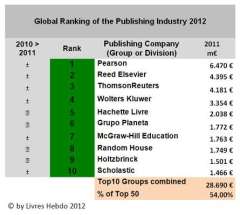
"The top five, as portrayed in the updated “Global Ranking of the Publishing Industry” shows, at the top, a bunch of old champions in the global knowledge society: British Pearson, made of the uncontested leader in Education, and one of the biggest brands in fiction and nonfiction Trade books, Penguin, followed by Reed Elsevier, Thomason Reuters and Wolters Kluwer, spearheading mostly digital services for scientific and professional information, and French Hachette, the new comer to knowledge in a truly worldwide perspective.
Those five companies are giants with yearly publishing revenues (not counting newspapers, magazines, TV of advertising) of more than 2 bn € (or 2.5 bn US$), and imposing a strong presence truly around the globe, to provide book or similarly ‘complex’ content, notably leading journals, to the world."
More: http://wischenbart.com/booklab/
### END OF POST ###
www.SPYWRITER.com
18/06/2012
Writers as products
Just as their books, writers too are only products to be traded and monetized upon:
"Consumers and publishers are coming to rely on branding to assure them of something; in the former, the assurance that the title will provide a certain, essential, worthwhile experience; and in the latter, that the brand will be profitable.
...the publishing industry has been using similar branding tricks for years. No matter how successful or talented your author, it's virtually impossible for anyone to write and release more than a single book in a year. What is labelled as the work of a successful author might contain the author’s ideas, characters, and plot, but actually be written by ghost writers."
Source: http://games.on.net/article/15295/Brand_and_Soul_Whats_in_a_Name
This writer still writes his own books!
### END OF POST ###
www.SPYWRITER.com
"Consumers and publishers are coming to rely on branding to assure them of something; in the former, the assurance that the title will provide a certain, essential, worthwhile experience; and in the latter, that the brand will be profitable.
...the publishing industry has been using similar branding tricks for years. No matter how successful or talented your author, it's virtually impossible for anyone to write and release more than a single book in a year. What is labelled as the work of a successful author might contain the author’s ideas, characters, and plot, but actually be written by ghost writers."
Source: http://games.on.net/article/15295/Brand_and_Soul_Whats_in_a_Name
This writer still writes his own books!
### END OF POST ###
www.SPYWRITER.com
09/04/2012
Book publishers confess
"Publishers confess they’ve goofed.
Here’s why: Book publishers have been very slow to realize this but gradually began to admit that they really didn’t know all that well what they’re doing.
Seriously. They don’t. And they know it. Fact: Nearly all published books – conservative estimates range between 80-90 percent – lose money. These books don’t earn out their advances, don’t have second printings, they sell in the low four digits at best, are returned from the retail accounts and pulped or recycled.
The rest have to make up for it, and often don’t. What kind of a business is that?
So as book publishers have begun to admit to themselves and even publicly that they can’t really predict what will sell or not, they’ve also realized that the old methods of selling, of marketing a book have stopped working."
More: http://blogs.forbes.com/booked/2011/06/06/good-day-sunshine-for-writers/
### END OF POST ###
www.SPYWRITER.com
Here’s why: Book publishers have been very slow to realize this but gradually began to admit that they really didn’t know all that well what they’re doing.
Seriously. They don’t. And they know it. Fact: Nearly all published books – conservative estimates range between 80-90 percent – lose money. These books don’t earn out their advances, don’t have second printings, they sell in the low four digits at best, are returned from the retail accounts and pulped or recycled.
The rest have to make up for it, and often don’t. What kind of a business is that?
So as book publishers have begun to admit to themselves and even publicly that they can’t really predict what will sell or not, they’ve also realized that the old methods of selling, of marketing a book have stopped working."
More: http://blogs.forbes.com/booked/2011/06/06/good-day-sunshine-for-writers/
### END OF POST ###
www.SPYWRITER.com
Writers do it
Margaret Atwood did it.
Edgar Rice Burrows did it.
Willa Cather did it.
Joseph Conrad did it.
Alexandre Dumas did it.
T. S. Eliot did it.
Nathaniel Hawthorne did it.
Ernest Hemingway did it.
James Joyce did it.
Rudyard Kipling did it.
D. H. Lawrence did it.
Anais Nin did it.
Edgar Allan Poe did it.
Ezra Pound did it.
Marcel Proust did it.
Beatrice Potter did it.
James Redfield did it.
George Bernard Shaw did it.
Upton Sinclair did it.
Gertrude Stein did it.
Henry David Thoreau did it.
Leo Tolstoy did it.
Mark Twain did it.
Walt Whitman did it.
Virginia Woolf did it.
You, too, can self-publish your book.
But you do not have to. Perhaps you cannot be bothered, and prefer someone else do it for you? You can find a publisher, even in this rough time for the industry. In order to stand out from the crowd of faceless writers vying for the attention of publishers you have to approach it just right. You can do it. You can find a publisher:
Edgar Rice Burrows did it.
Willa Cather did it.
Joseph Conrad did it.
Alexandre Dumas did it.
T. S. Eliot did it.
Nathaniel Hawthorne did it.
Ernest Hemingway did it.
James Joyce did it.
Rudyard Kipling did it.
D. H. Lawrence did it.
Anais Nin did it.
Edgar Allan Poe did it.
Ezra Pound did it.
Marcel Proust did it.
Beatrice Potter did it.
James Redfield did it.
George Bernard Shaw did it.
Upton Sinclair did it.
Gertrude Stein did it.
Henry David Thoreau did it.
Leo Tolstoy did it.
Mark Twain did it.
Walt Whitman did it.
Virginia Woolf did it.
You, too, can self-publish your book.
But you do not have to. Perhaps you cannot be bothered, and prefer someone else do it for you? You can find a publisher, even in this rough time for the industry. In order to stand out from the crowd of faceless writers vying for the attention of publishers you have to approach it just right. You can do it. You can find a publisher:

16/03/2012
Authors responsible for high cost of books
"In his forthcoming book [...] the American author Robert Levine has an excellent chapter on publishing in which he interrogates the forces driving the pricing of books, in both their paper and digital forms. And some of the explanations he gives are (to me at least) surprising. For example, it turns out that "publishers only spend $3.50 to print and distribute a hardback". (Let's say it's £3 in Britain.) So when, this autumn, you go into your local bookshop and spend £30 [...] you really are just putting a large amount of profit into the hands of [...] publisher, with some knocked off for the retailer. Right?
Well, yes and no. If you think of books primarily as physical objects, then off course they'll seem a rip-off, because printing and distributing them is cheap. But as Levine points out, what you're really paying for when you buy a book is something different. You are buying the "text itself". And why is that so expensive? Because the publisher will, in many cases, have paid the author a considerable sum for the right to sell it.".
Source: http://www.guardian.co.uk/books/booksblog/2011/aug/04/price-publishing-ebooks
Ha.
Ha.
That "considerable sum", dear reader, amounts to somewhere between 4-8%.
### END OF POST ###
www.SPYWRITER.com
Well, yes and no. If you think of books primarily as physical objects, then off course they'll seem a rip-off, because printing and distributing them is cheap. But as Levine points out, what you're really paying for when you buy a book is something different. You are buying the "text itself". And why is that so expensive? Because the publisher will, in many cases, have paid the author a considerable sum for the right to sell it.".
Source: http://www.guardian.co.uk/books/booksblog/2011/aug/04/price-publishing-ebooks
Ha.
Ha.
That "considerable sum", dear reader, amounts to somewhere between 4-8%.
### END OF POST ###
www.SPYWRITER.com
02/03/2012
Writing as a manufacturing job
Writing books is a job, not unlike that of a worker on a manufacturing line, where the publishing model forces one to churn out books as mass products (consider a certain suspense writer who signed a publishing contract to produce and deliver 17 novels in 3 years):
"Since when did being a writer become a career choice, with appropriate degree courses and pecking orders? Does this state of affairs make any difference to what gets written?
In the last thirty or forty years, the writer has become someone who works on a well-defined career track, like any other middle class professional, not, however, to become a craftsman serving the community, but to project an image of himself (partly through his writings, but also in dozens of other ways) as an artist who embodies the direction in which culture is headed.
One of the myths about creative writing courses is that students go there to learn how to write. Such learning, when and if it takes place, is a felicitous by-product that may or may not have to do with the teaching; the process of settling down to write for a year would very probably yield results even without teachers. No, the student goes to the course to show himself to teachers who as writers are well placed (he imagines!) to help him present himself to the publishers. Most creative writing courses now offer classes on approaching agents and publishers and promoting one’s work. In short, preparing for the job."
More: http://www.nybooks.com/blogs/nyrblog/2012/feb/28/writers-job/
### END OF POST ###
www.SPYWRITER.com
"Since when did being a writer become a career choice, with appropriate degree courses and pecking orders? Does this state of affairs make any difference to what gets written?
In the last thirty or forty years, the writer has become someone who works on a well-defined career track, like any other middle class professional, not, however, to become a craftsman serving the community, but to project an image of himself (partly through his writings, but also in dozens of other ways) as an artist who embodies the direction in which culture is headed.
One of the myths about creative writing courses is that students go there to learn how to write. Such learning, when and if it takes place, is a felicitous by-product that may or may not have to do with the teaching; the process of settling down to write for a year would very probably yield results even without teachers. No, the student goes to the course to show himself to teachers who as writers are well placed (he imagines!) to help him present himself to the publishers. Most creative writing courses now offer classes on approaching agents and publishers and promoting one’s work. In short, preparing for the job."
More: http://www.nybooks.com/blogs/nyrblog/2012/feb/28/writers-job/
### END OF POST ###
www.SPYWRITER.com
Subscribe to:
Posts (Atom)