30/10/2011

Ritzkrieg of Wartime London

image

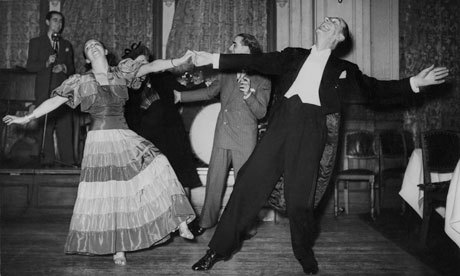
"The Savoy of this period, like London's other grand hotels, was a locus of powerful resentment: a building that symbolised the tenacity of privilege during wartime. There was even a word that went with it – Ritzkrieg – the campaign through which rich Londoners protected their perks and pleasures. But it was also possible to see it as the site of a peculiarly British form of resistance – a place in which quickstepping and drinking pink gin became a patriotic activity; where socialites bibbed for England to demonstrate that Hitler was not sufficiently powerful to disrupt the rituals of cocktail hour. The grand hotels were sensible places to make such a stand. The Dorchester reminded wartime guests that it was, at the skeletal level, a mesh of thick metal cables sunk into a raft of reinforced concrete. The Ritz ballyhooed the fact that its Belle Epoch curlicues concealed steel girders worthy of an American skyscraper. (They neglected to mention that the steel was German.) And under this somewhat illusory impression of safety, the statesmen, spooks and five-star refugees checked in. The Savoy, the Dorchester, the Ritz, Claridge's: each one became a kind of Casablanca.


At the Savoy, journalists filed articles from makeshift offices carved from the carcasses of once-expensive suites. Con artists and swindlers, invigorated by the opportunities brought by war, hunted for victims among the potted palms. Illegal abortionists, profiting from the wartime increase in unwanted pregnancies, conducted their business behind locked hotel-room doors. Spies and spymasters made the grand hotels into thriving centres of espionage, using quiet suites for debriefings and interrogations and picking at the plasterwork for hidden microphones. MI5 booked a suspected Nazi double agent called Stella Lonsdale into a room at the Waldorf, and waited for her to crack. Guy Burgess installed a pair of spies at the Dorchester, one a painfully handsome 19-year-old with 10 targets on his watch list – mainly homosexual Magyars (Hungarians) who were charmed by his unfingermarked good looks. "The whole place," shuddered the head of Special Branch, "is crawling with foreigners."

More: http://m.guardian.co.uk/travel/2011/oct/30/sex-politics-spying-londons-wartime-hotels?cat=travel&type=article

27/10/2011

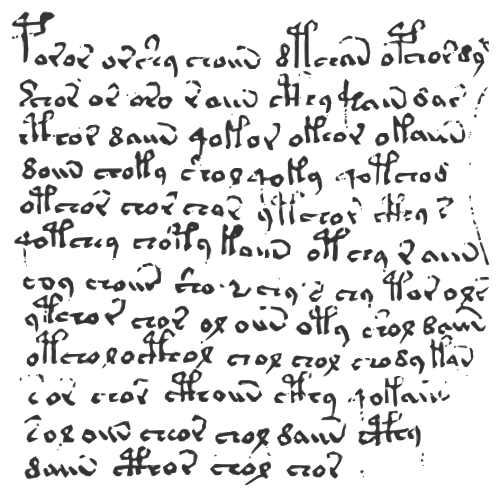
The Voynich Manuscript dates to the early 15th Century


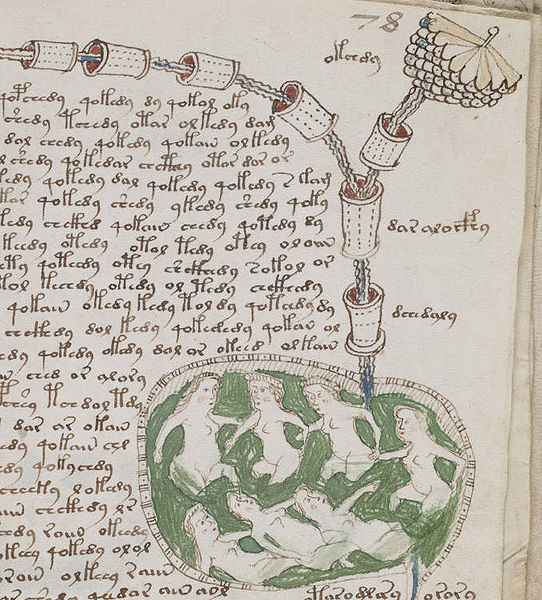
"University of Arizona researchers have cracked one of the puzzles surrounding what has been called "the world's most mysterious manuscript" -- the Voynich manuscript, a book filled with drawings and writings nobody has been able to make sense of to this day.

Using radiocarbon dating, a team led by Greg Hodgins in the UA's department of physics has found the manuscript's parchment pages date back to the early 15th century, making the book a century older than scholars had previously thought.

Currently owned by the Beinecke Rare Book and Manuscript Library of Yale University, the manuscript was discovered in the Villa Mondragone near Rome in 1912 by antique book dealer Wilfrid Voynich while sifting through a chest of books offered for sale by the Society of Jesus. Voynich dedicated the remainder of his life to unveiling the mystery of the book's origin and deciphering its meanings. He died 18 years later, without having wrestled any its secrets from the book.

"Is it a code, a cipher of some kind? People are doing statistical analysis of letter use and word use -- the tools that have been used for code breaking. But they still haven't figured it out."

More: http://www.sciencedaily.com/releases/2011/02/110210153016.htm

How to foretell a dictator

image

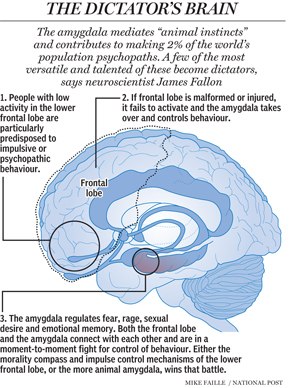
How to foretell a dictator? By scanning his brain (which, perhaps, should be a pre-requisite for all presidential candidates):


“They are usually charming, charismatic and intelligent,” wrote James Fallon, an American neuroscientist, in Psychology Today.


“They brim with self-confidence and independence, and exude sexual energy. They are also extremely self-absorbed, masterful liars, compassionless, often sadistic and possess a boundless appetite for power.”


Col. Gaddafi was “paranoid, narcissistic, power-hungry and vain,” he said.


After studying the behaviour of dictators, Mr. Fallon determined that genes, upbringing, abnormalities in the brain and a lack of empathy all played a role in forming such a person.


And, he concluded, “It is no coincidence that all dictators are men."


More: http://fullcomment.nationalpost.com/2011/10/22/peter-goodspeed-abnormal-brains-only-partly-explain-what-makes-someone-a-dictator/

26/10/2011

Blooming spring in autumn | LitBash 45


Autumn gets you down? Prefer Spring? Every book is a blooming flower. Enter the garden - start with authors who were...

Born this week:

Armand Lanoux, France

Venedict Yerofeyev, Russia

Ulrich Plenzdorf, Germany

Erasmus, Netherlands

"The most disadvantageous peace is better than the most just war."

Kare Holt, Norway

Sylvia Plath, USA

"Nothing reaks quite as bad as a pile of unpublished manuscripts."

Evelyn Waugh, UK
"Aesthetic value is often the by-product of the artist striving to do something else."

Otto Flake, Germany

Jean Giraudoux, France

"As soon as war is declared it will be impossible to hold the poets back. Rhyme is still the most effective drum."

Jean Rostand, France
"Kill a man, one is a murderer; kill a million, a conqueror; kill them all, a God."

Carl Erik Soya, Denmark

Died this week:

Mary McCarthy, USA
"We all live in suspense, from day to day, from hour to hour; in other words, we are the hero of our own story."

Gerard Walschap, Belgium

Carlo Collodi, Italy
Pinocchio

Arkady Gaidar, Russia

Heinz Piontek, Germany

Willi Bredel, Germany

Walter Raleigh, UK

"Better were it to be unborn than ill-bred."

Nikolai Chernyshevsky, Russia
"History is fond of her grandchildren, for it offers them the marrow of the bones, which the previous generation had hurt its hands in breaking."

Frances Burnett, UK
"And this, my lovely child, is your garden."

William Wharton, USA
"What is love? As far as I can tell, it is passion, admiration, and respect. If you have two, you have enough. If you have all three, you dont have to die to go to heaven."

Pio Baroja, Basque

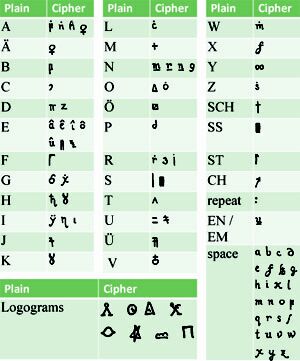
Copiale Cipher, an 18th century secret code is broken


The "75,000-character Copiale Cipher finally has been broken.

The mysterious cryptogram, bound in gold and green brocade paper, reveals the rituals and political leanings of an 18th-century secret society in Germany. The rituals detailed in the document indicate the society had a fascination with eye surgery and ophthalmology, though it seems members of the society were not eye doctors."

The code was broken by a team led by Kevin Knight.

"To break the cipher, Knight and colleagues Beáta Megyesi and Christiane Schaefer of Uppsala University in Sweden tracked down the original manuscript, which was found in the East Berlin Academy after the Cold War and now is in a private collection. They transcribed a machine-readable version of the text, using a computer program created by Knight to help quantify the co-occurrences of certain symbols and other patterns."

Read more: http://www.sciencedaily.com/releases/2011/10/111025102320.htm

25/10/2011

The day Nixon wanted to blow up the world

"For two weeks in October 1969, the Nixon Administration secretly placed U.S. nuclear forces on alert.  [...] Still today, no conclusive explanation for the potentially destabilizing alert can be found. 


“There are two main after-the-fact explanations: first, that nuclear brinkmanship was designed to convince the Soviets that President Nixon was prepared to launch a nuclear attack against North Vietnam in order to convince Moscow to put pressure on Hanoi to negotiate an end to the war in Southeast Asia” along the lines that previous historians have suggested.


The second proposed explanation is “that the President ordered the alert as a signal to deter a possible Soviet nuclear strike against China during the escalating Sino-Soviet border dispute.”  Consistent with the second interpretation, the FRUS volume provides new documentation of intelligence reports indicating that Soviet leaders were considering a preemptive strike against Chinese nuclear facilities.


Astonishingly, even the most senior U.S. military leaders were kept in the dark by the White House about the nature of the alert– before, during and after the event."


More: http://www.fas.org/blog/secrecy/2011/10/1969_nuclear_alert.html

WikiLeaks is dying. WikiJustice is born.

WikiLeaks may cease to exists because there is no way to support it financially (though not for the lack of will among the 99-percenters).

"The shutting down of the WikiLeaks website due to financial problems is unfortunate, even though it had become almost inevitable that its end was nigh. Organisations such as Mastercard, Visa, Western Union and PayPal, though not directly funding WikiLeaks, were effective channels for those who wanted to donate to it from across the world. Once they withdrew support, the donations dried up and the website ran out of cash, after which staying afloat was a struggle. Though no one will officially admit it, the connection between these organisations’ refusal to allow donations to go through them and the United States government’s displeasure at disclosures made by WikiLeaks is too blatant to be ignored." source

How is it possible that no channel exists in the entire world by which a person could support WikiLeaks? It's because of what you always suspected: a handful of companies control the entire financial / economic system:

"The work, to be published in PLoS One, revealed a core of 1318 companies with interlocking ownerships (see image). Each of the 1318 had ties to two or more other companies, and on average they were connected to 20. What's more, although they represented 20 per cent of global operating revenues, the 1318 appeared to collectively own through their shares the majority of the world's large blue chip and manufacturing firms - the "real" economy - representing a further 60 per cent of global revenues.

When the team further untangled the web of ownership, it found much of it tracked back to a "super-entity" of 147 even more tightly knit companies - all of their ownership was held by other members of the super-entity - that controlled 40 per cent of the total wealth in the network. "In effect, less than 1 per cent of the companies were able to control 40 per cent of the entire network," says Glattfelder. Most were financial institutions." source

Do not despair! WikiLeaks may suspend its operations, perhaps even cease to exist, but WIKIJUSTICE will set things straight: